
Scuttled: How America Sank Its Own Navy
Why the world's strongest navy chose its own decline

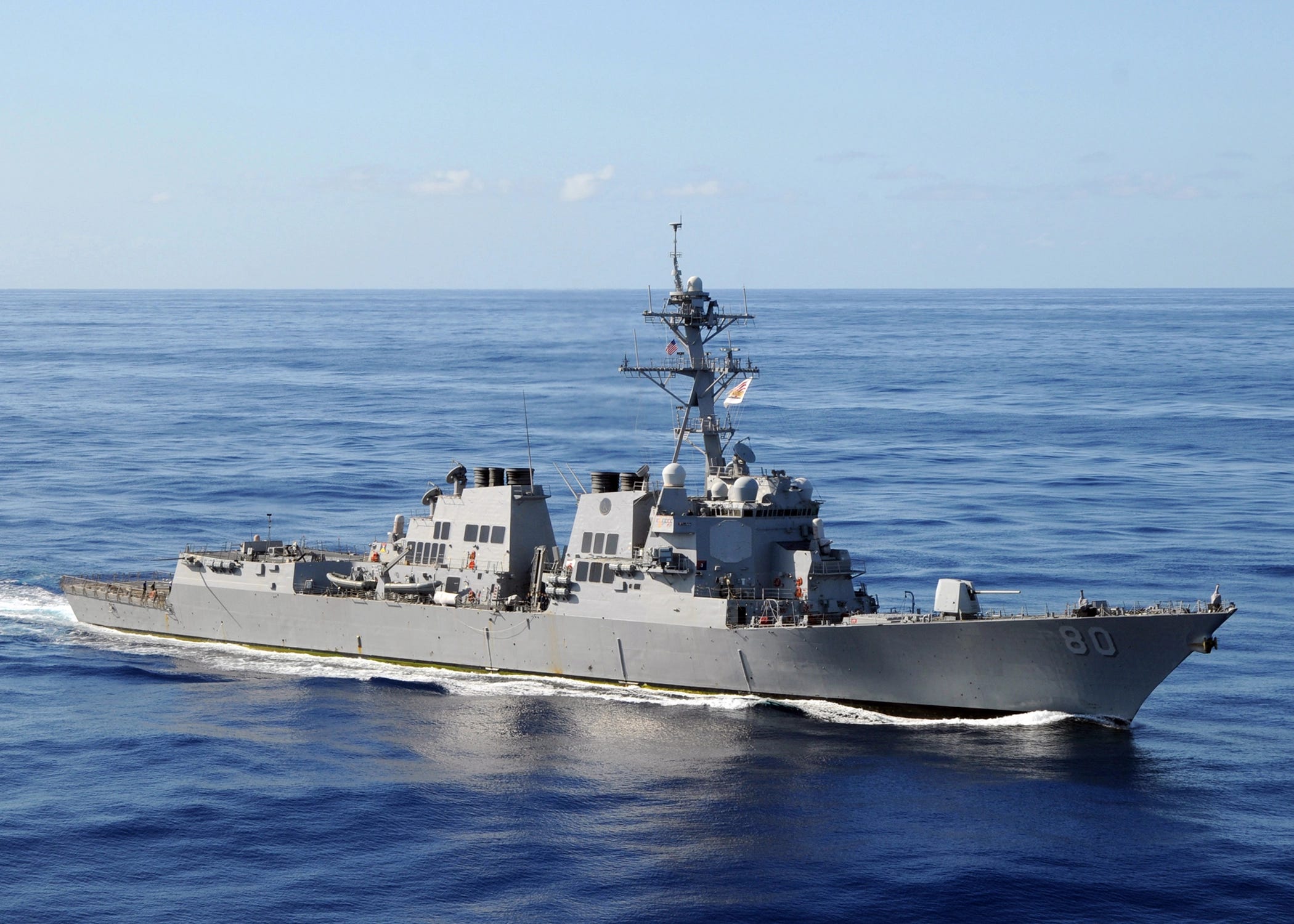
The story of the US Navy (USN) since the end of the Cold War is one of managed decline. The previous generation of procurement, largely completed in the 1980s, produced the world’s most powerful fleet, designed for peer competition on a global scale. But the decades thereafter saw that competitor’s utter collapse, ushering in an age of unparalleled American ascendancy. In the generation that followed, small-scale counterinsurgency warfare was the modal conflict, and in that, the US Navy found itself both over-provisioned and unchallenged. Its $2 billion Arleigh Burke destroyers, firing $2 million interceptors through their arrays of vertical-launch system (VLS) cells, were reduced to swatting $20,000 Houthi attack drones out of the sky, while its supercarriers, built to break the Soviet navy, now chased pirates along the Horn of Africa.
No one in the 1980s expected the USSR’s imminent collapse. The military planners of that decade, just like those from the decades preceding, considered themselves the latest inheritors of America’s generational struggle. They expected to pass that same burden to their successors.
This perspective was epitomized by secretary of the Navy John Lehman. As the Navy’s political head for the entire Reagan administration, he saw Brezhnev’s (and later, Gorbachev’s) USSR not as Carter’s fading superpower, but as the existential threat to American hegemony it once was. He considered direct NATO-Warsaw Pact war an actual possibility and saw the Navy as core to that conflict.
His strategy for that war was one of encirclement. The USN would use carrier strike groups to push into the Norwegian Sea, the Mediterranean, and the Western Pacific to attack the Soviet fleet in its home waters. Swarms of attack submarines would threaten the USSR’s nuclear submarine “bastions” in the Barents Sea (by Murmansk) and the Sea of Okhotsk (near Kamchatka), forcing the Soviet navy to remain at port. His plan aimed to defang the 3-million strong Red Army, stationed along the Iron Curtain, by preventing them from marching into Western Europe.
Achieving this plan required a 600-ship fleet, he claimed, and that became the Navy’s public target. Lehman called for serial production of known classes, faster development of new classes, and commissioned a set of new ship designs for the future. He aimed for 15 Nimitz-class carriers (with their accompanying strike groups) for power projection, 100 Los Angeles-class nuclear attack submarines for undersea dominance, and 238 total surface combatants—cruisers, destroyers, and frigates—for general-purpose usage. To this end, the Navy made bulk-buys of the Nimitz class carriers, doubled output of the Los Angeles class submarines, and expanded the procurement targets for the in-development Ticonderoga cruisers and Arleigh Burke destroyers. He also revived the WW2-era Iowa battleships and refitted them with Tomahawks for modern usage. Under his leadership, the Navy also commissioned the successor to the Los Angeles class, the Seawolf attack submarines. These were the most expensive submarines ever constructed, designed exclusively for hunter-killer missions on other submarines. They would be the tip of the spear in the proposed invasion of the USSR.
By 1987, the Navy reached its historical peak of 594 ships. That year, during the Iran-Iraq War, the US launched Operation Earnest Will to escort ships through the Strait of Hormuz. The USN peeled off 30 ships—primarily Perry-class frigates—from its fleet to escort a ship a day through the strait, and it maintained this for months without compromising its duties anywhere else. This allowed Kuwait to continue exporting oil through the explosive conflict that surrounded it.
Reagan left office in 1989, and George H.W. Bush oversaw America’s annus mirabilis of 1991—the most pivotal year in modern history. That January, Bush ordered Operation Desert Storm, where the US Navy, Air Force, and Army stopped the Iraqi invasion of Kuwait with only 113 enemy-caused deaths. And in December, the USSR collapsed. The Iron Curtain had already fallen two years before, but the final end of the communist menace presaged a full decade of Russian geopolitical irrelevance.
America stood triumphant astride the world like a new Colossus of Rhodes.
The decades thereafter were marked by contracting military ambition. The Seawolf class was cut from 29 submarines to just 12, and then canceled after just 3. It was replaced by the Virginia class, which was much cheaper but lacked the Seawolf’s attack capabilities. The Perry-class frigates were retired in 2015, the Ticonderoga-class cruisers were aggressively decommissioned from 2004 onwards, and neither were replaced. The Arleigh Burke class, originally destined for the same fate, was belatedly kept alive when the Navy realized that without it, it wouldn’t have any surface combatants left.
Nowadays, the USN only operates 295 ships—about half of its 1987 peak. Almost all of these are old designs, produced in that final Cold War burst in the 1980s. These are all approaching their stated service life, and as they’re retired, the fleet will only contract further. By 2027, this will fall to 283 ships, before rising slightly to 294 ships in 2030.
But as the Navy committed itself to self-imposed decline, China came into its own as a new competitor, reopening the possibility of peer conflict. In one sense, this was predictable. Even in 1991, China showed early signs of the industrial power it would become, and by the 2000s, its rise was eminently obvious. And even if China had liberalized, as the delusional optimism of the Clinton and Bush presidencies so-confidently claimed, the US would still have had to reorient itself towards a new battle for global supremacy1.
China’s Navy, the People’s Liberation Army Navy2 (PLAN) hit an inflection point in the 2010s. The Chinese commercial shipbuilding sector displaced Korea’s as the world’s largest, and these new shipyards enabled a massive expansion of the Chinese Navy itself. By 2019, the PLAN was the world’s largest navy, and the gap has only grown since. Today it fields 370 ships, a total projected to rise to 425 by 2030.
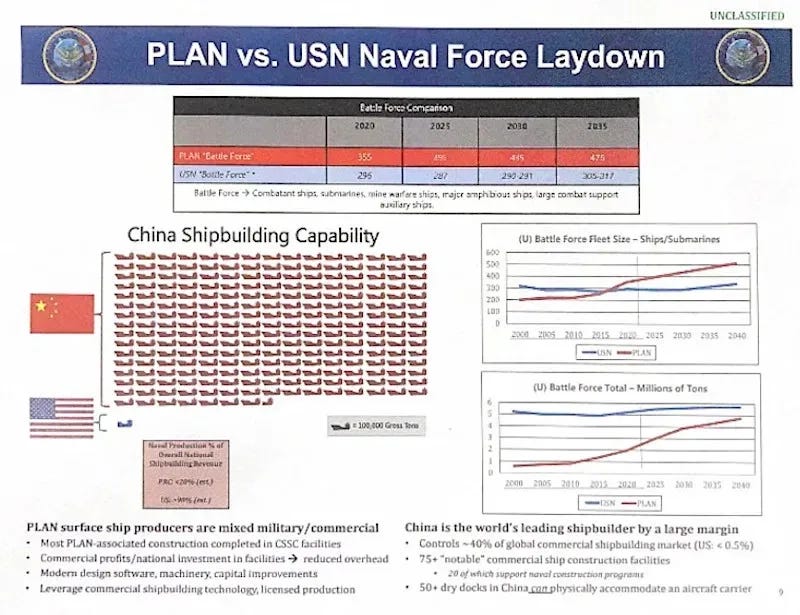
To be clear, this does not imply the PLAN has exceeded the USN’s combat capacity. The USN has 11 carriers to China’s 3, 75 destroyers to China’s 50, and 71 nuclear submarines to China’s 32. The modal Chinese ship is a 1500 ton Corvette, designed for coastal patrols along its borders. Its capstone blue water (i.e ships for oceanic use, instead of littoral or riverine usage) ships are far less numerous. The USN’s navy, on the other hand, is almost entirely blue water oriented. Its modal ship is the 9000 ton Burke-class destroyer, it has double the total tonnage of the PLAN, and more than double the total number of VLS cells.
Rather, this shows that the USN’s delusion of eternal preeminence was just that—a delusion. It now faces aggressive competition, arguably much more formidable than the USSR ever was, and will need to redesign itself once again for peer conflict. This particular measure is an indicator of the derivative. China has shown it has massive volume-construction capability and it is rapidly building capabilities to match the USN’s top-end vessels.
For example, of the PLAN’s 32 nuclear submarines, almost half of them have come online in the last five years alone. China currently can produce 3 guided-missile nuclear submarines per year—2.25 times American capacity, with further expansion ongoing. Similarly, the PLAN has built 45 latest-generation destroyers over the past decade, with another 14 under construction. These are rumored to have a dual-band radar that the USN’s Zumwalt program was intended to integrate, and their upgraded VLS cells can launch hypersonic anti-ship missiles.
Meanwhile, the US struggles at every level of ship construction. New ships die in procurement, as an atrophied naval design arm is unable to produce practical designs. Existing designs can’t be produced at scale. Even for well-known ship designs with many existing examples, the Navy struggles to increase production. The Virginia class of submarines, a mature design that launched in 2003, has been flatlining at an average of 1.33 produced per year. The Navy projects this increasing to 2 per-year—in 2032. The Arleigh Burke destroyer, conceived in the 80’s, was produced at about 5 ships a year from 1989 to 2005. Nowadays, that number is down to 2—half of its peak, in a forty year-old design. Compare this to the 14 surface combatants the PLAN is concurrently building.
If this trend continues, China will both have the USN’s high-tech capabilities and be far more able to replace its losses. The USN, on the other hand, depends on an aging fleet, and as its ships are retired, their replacements aren’t forthcoming. Its technological edge will shrink just as its physical capacity degrades to nought.
Nor is a technological edge sufficient for the effective operation of a blue-water navy. Right now, Iran is launching missiles and drones at commercial ships crossing the Strait of Hormuz, scaring off commercial traffic. The USN doesn’t have enough escort ships to prevent this. At most, it has 75 Arleigh Burke destroyers, 9 guided missile warships, and 3 littoral combat ships, and almost every single one of these ships is already in use elsewhere. So far, the USN has moved 2 destroyers to the Persian Gulf, and over the last 3 months, has used them to escort exactly 2 cargo ships through the Strait. Where in Earnest Will, the US maintained Kuwaiti exports by force of arms, today Kuwait’s oil exports have fallen almost to nothing and the USN doesn’t have the capacity to intervene.
Consider other operations. Hypotheticals about war over Taiwan focus on carriers and amphibious assault, but neglect a far more basic capability: sealift. Any such war would require supplying an island hundreds of miles from any US military base for months, while it faces a probable naval blockade, arrays of anti-ship missiles, and attacks from shore-based launchers on the Chinese mainland. This would require a fleet of cargo ships, a huge escort operation, and a constant rotation of ships in and out of dockyards for repair and upkeep.
The USN of today doesn’t have the materiel, the personnel, or the facilities to bear this specific burden. The Ready Reserve Force (RRF), a fleet of 51 ships providing surge cargo capacity during naval engagements, is a hospice fleet, with an average ship-age of 45 and dozens of those ships more than 50 years old. In the last empirical readiness test in 2019, only 40% were capable of being put to sea without major repairs. The biggest gap is in fuel tankers. The USN has between 21 to 25 tankers in inventory, while projections say that any war in the Pacific would require at least 69. And because the US is almost devoid of commercial shipbuilding capacity, this expansion has to be acquired from foreign partners. This fuel bottleneck could leave the America’s largest advantage, its air force, grounded, unable to sortie from its supercarriers.
And finally, even if the RRF was fully operational with the correct complement of ships, it’s not clear the US has the manpower to staff it. The death of the merchant marine means there isn’t a base of mariners to hire into service in wartime, and hiring foreign crews is fraught with difficulty.
The USN is even losing the capability to maintain its current fleet. After a round of closures in the 1990s, the US has only four shipyards left that can maintain its nuclear carriers and submarines. The dry-docks and production facilities in these are, on average, 76 years old, and without major upgrades, they will not be able to support over a third of planned carrier and submarine maintenance periods by 2040. Attack submarines, in total, incurred 10,363 days of idle time between 2008 and 2018. Ships of all sorts have waited 33,700 more days than projected for maintenance. Together, this is as if 9 warships and 3 submarines were removed from the fleet entirely over that period.
Repairing and upgrading shipyards faces the same disease that building ships does. Updating the Portsmouth dry dock ballooned from $528 million to $2.2 billion between 2019 and 2021, while Pearl Harbor’s estimate exploded from $6.1 billion to $16 billion. This lack of capacity meant that in 2020, when the $750 million Bonhomme Richard was damaged in an accidental fire, the cost of repair was quoted at $3.2 billion: higher than the ship’s initial purchase price. The USN was forced to scrap it. In 2024, out of desperation, the USN began contracting naval maintenance for non-combat ships to Korea. Hanwha, HD Hyundai, and HJ Heavy Industries have overhauled eight USN ships in two years—several times faster than any American shipyard could manage.
Atrophied Foundations
But the USN is not a spent force. Despite headwinds, it has retained the technological frontier in naval technology and it continues to push that frontier forward. American marine nuclear reactors remain a step above their Chinese counterparts, with proven reliability, safety, and operational experience—which are really the crux of nuclear propulsion. America also retains a considerable edge in carriers. The USS Gerald R. Ford is a nuclear-powered capital ship that can sustain months-long deployments—it just completed one that lasted 326 days—and carries an air force larger than most nations’; meanwhile, China’s latest Fujian class is conventionally powered and considerably smaller.
Chinese submarines also have notably worse acoustic quieting. Essentially “underwater stealth,” this is a branch of engineering focused on reducing the vibrations produced by an operating submarine to prevent its detection by SONAR. It requires full harmony between the hull, the engine, the propulsion mechanism, and the surfaces, to minimize sound output, and the small margins mean simulation is not sufficient. Strong acoustic quieting takes years of experimentation to perfect, and China’s latest submarines remain a generation behind their American counterparts. This concern for survivability still constrains Chinese submarines on patrols outside the South China Sea.
If these seem like mere “details,” consider that a carrier that requires refueling is not one that can spend three months in the Persian Gulf as the headquarters of the largest power projection operation in history. A submarine that’s visible to enemies is just a slow, clumsy ship that can’t carry many missiles. China can build the legible technological targets, but the most specialized outputs, built on accumulated institutional memory, remain out of reach. China could not, today, execute the current Iran War. And if the roles were reversed, and China was the one tasked with a military takeover of an island 2000 miles from its shores, its “timelines” would be stretched by another two decades.
But that’s not the world we live in. Instead, the USN is tasked with defending that island, and the fleet it has is not sufficient. It was largely designed and constructed more than two decades ago for a previous generation of leaders’ conception of the war of the future. Their predictions were seemingly correct—the USN has performed exceptionally well in recent conflicts, and the PLAN’s goal is roughly to mimic the current disposition and armaments of the US Navy. The fleet they’re building now is a mirror of the one the USN already has.
What isn’t clear is how the USN will rebuild today for the war of our future.
The Navy certainly understands the problem—they’ve been trying to reinvent themselves since the 2000s. The fabled “pivot to Asia” was announced by the first Obama administration, when Leon Panetta, the secretary of Defense, planned to anchor 60% of the US Navy in ports in the Pacific. He explicitly revived John Foster Dulles’ concept of encirclement along the First Island Chain (i.e. from Kamchatka to the Malay peninsula). And many of the Navy’s recent ship designs were pioneered in that era to fill crucial roles in a Pacific war.
Yet this change in rhetoric has not led to actual change. Despite two decades of posturing, the pivot to Asia has not happened. America’s naval facilities across the first island chain are woefully insufficient for a war over Taiwan. Those new warship classes, announced from 2001 onwards, do not exist in any meaningful form.
And at the same time, as we discussed above, the Navy has steadily lost the capacity to perform the basic tasks necessary of a blue-water force. It struggles to build existing ship designs. It cannot cost-effectively repair, refurbish, or upgrade its ships. It can’t even maintain readiness of its essential reserve fleet, which itself was designed specifically for the war that now looks imminent.
Indeed, after three decades of cost-cutting, the Navy has forgotten how to effectively expend resources to expand national power. Large-scale procurement, once America’s great strength, has now become a morass. The Navy’s in-house ship design arm has atrophied, leading to unrealistic, outsourced designs that aim to accomplish too much. Contractors are incentivized to build before designs have been completed because they’re aiming to lock-in an appropriation and thus new revenue and they aren’t graded by the functionality of the final product. Years of consolidation and decline in the industry have also left the Navy with few choices for vendors and little opportunity for competitive bidding. The very scarcity of the Navy’s procurements has become an obstacle. Each ship is now designed to handle all possible functions because new design opportunities are so infrequent.
Failures in procurement compound with America’s overall declining industrial base, which makes it slow and costly even to produce existing ships. Ships require large and specialized facilities for construction. They need legions of skilled tradespeople to weld steel, fabricate hulls, fit pipes, install complex electrical wiring, and forge a multitude of custom components. Integrating radar, combat systems, and VLS cells into different hulls is complex work that is done custom for each ship, and has to be reimplemented for each new component upgrade. Marine nuclear reactors have a massive quality assurance and safety certification regime before they can be installed on ships and submarines. There are only four companies in the US, which operate seven different shipyards, that the Navy can rely on to construct new ships. For submarines and carriers, this number is down to two yards, which work together to build one ship at a time. And for conventional surface combatants, the average time to produce an Arleigh Burke destroyer, which trended downwards for a decade, is now longer than at its commissioning in 1991.
This decline is accelerated because American shipbuilding is a monopsony. The Navy is the only buyer of any scale, apart from small-scale operators of Jones-act compliant ships. This meant that Navy funding cuts and accompanying demand decrease destroyed the entire industry. It also means that even with Navy demand, shipyards never make the capital investment to increase production rates because Navy demand is low-volume (relative to commercial orders) and entirely bespoke. This means even the things that can be standardized via bulk assembly, like hull fabrication or casting, are still done by hand. And shipbuilding is also an oligopoly: just as shipbuilders can only sell to the Navy, the Navy has very few options on who it can buy from. The dearth of competition allows builders to bank Navy revenue as profit instead of reinvesting it into improvements.
For comparison, China built its world-leading commercial shipbuilding industry before its naval expansion. The PLAN’s success in volume construction comes directly from that commercial success: PLAN destroyers and carriers are built literally next to commercial tankers, and the workforce and techniques carry through to both. Chinese shipyards invest in automation to optimize commercial ship production, and then apply as much standardization as possible to naval orders so they can reuse their equipment and process. This means PLAN vessels are designed from inception for volume. And while naval construction is distinct from commercial construction, the biggest constraints in the American industry are workforce continuity and industrial base expansion, and both of those have significant overlap with the commercial industry. The vast majority of work on non-nuclear warships is the large-scale welding, wiring, and electronic installation present on commercial cargo ships, and so, nurturing the cargo industry buttresses the Navy’s own capabilities. Thus, any plan (pun-intended) to expand the US Navy’s production must also include rebuilding America’s commercial shipbuilding industry.
The New Generation
History officially ended for the US Navy in 1994, when John Dalton, secretary of the Navy, published “ Forward…From the Sea”, his redesigned mission for the Navy in a world without equals. He proposed a naval force where oceanic control is assumed and blue water operations subside to shore-based power projection. The US Navy no longer combated other navies because there were none left that merited the effort; rather, the Navy was just another tool for enforcing American will against the small actors that dared defy it.
After Russia, America’s next naval missions were ending genocide in Bosnia, guarding civilians in the Somali Civil War, redirecting fleeing refugees from Cuba, and undoing the latest Haitian military coup. In each, the oceanic Navy was over-provisioned for its task. A slew of retirements followed. The Perry-class frigates were all decommissioned in 2015. The Ticonderoga-class cruisers are following the same arc thereafter. And whatever was left of the Cold War leadership sank to grief.
By 2002, the Navy realized it was now under-provisioned for these missions. Its frigates were slated for retirement and both its minesweepers and its patrol boats were aging classes and needed renewal. This meant there wasn’t a ship designed for core near-shore functions: clearing mines, destroying smaller submarines, and fighting off smaller boats, the tasks that encapsulated most of the Navy’s new missions. Instead of replacing each of these functions separately, however, the Navy planned a single ship that could use replaceable modules to accomplish all of these tasks. This was the Littoral Combat Ship. It was intended to be a cheap (by naval standards), expendable hull, with a small crew, so it could be distributed across all of the various littoral areas the US patrols.
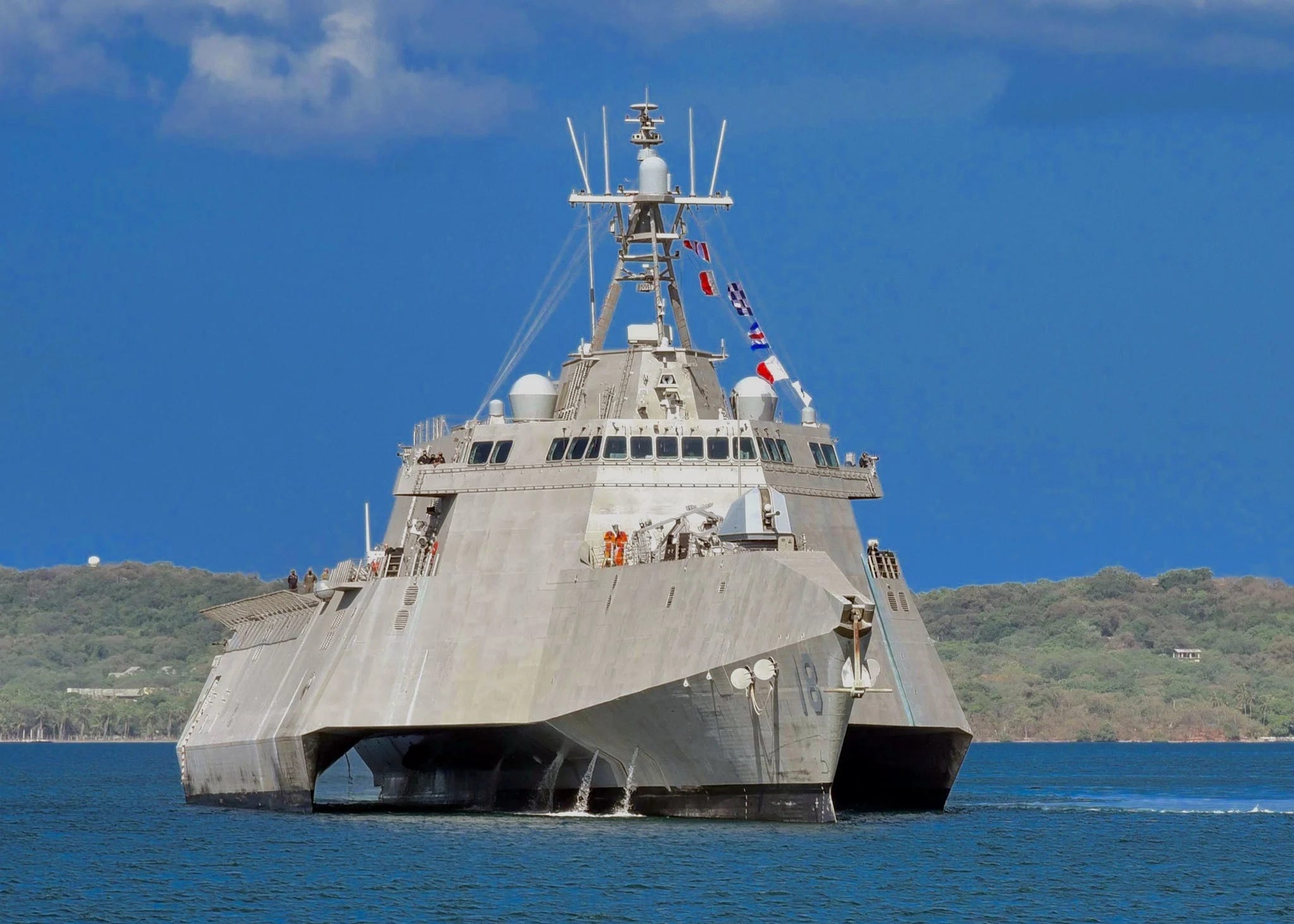
But the program ran into issues from the very outset. The Navy couldn’t choose between two designs, so it commissioned both: doubling training costs, spare parts requirements, and assembly lines for the entire program. Then, the scope expanded, as the LCS absorbed requirements from the retiring Perry-class frigates. This meant that the fast, lightly-armed coastal ship now also had to be a heavily armored surface combatant with VLS capability. Consequently, the LCS adopted exotic hull shapes and major increases in displacement so it could hold the massive engines it needed to be both fast and armored. Suddenly, the “cheap” hull already rose to a $600 million unit cost. Then, the expanded hull couldn’t be manned by the original crew size of 40, so that had to increase to 70, almost doubling workforce requirements.
And then, every aspect of the modules—remember, the core of the entire ship—failed to match expectations. The surface warfare module’s centerpiece was the non-line of sight missile launcher, but that was canceled halfway through development, leaving it only partially effective. The Mine Countermeasures went through three iterations, expanding into a much more expensive system of underwater drones, helicopter-carried monitoring systems, and a set of autonomous boats carrying SONAR. And the submarine warfare module never came into being at all, because despite hundreds of millions spent on fitting a custom variable-depth SONAR array to the ship, it became obvious that a fast ship that burns a lot of fuel is ill-suited for loitering in one place for a long time to scan for underwater threats.
The capstone of this dismal story came in 2014, when the module mechanism itself was written off. Originally, modules were intended to take “a few days” to fit on any decently equipped pier. Instead, on both LCS variants, it took over six weeks at a shipyard to swap between modules, which eliminated their primary utility. Eventually, the Navy just welded the modules permanently to each hull.
This experimentation took, in total, twenty years, and the failure was amplified because the ships started construction before any of the actual complexities in the module design or the crew requirements were ironed out. The first hull finished in 2008, but was unable to accomplish any of its stated tasks. Then, the Navy iterated on two versions of each module on each ship variant for 10 years until finally, in 2016, the module concept was abandoned, the anti-submarine and anti-surface boat concepts were dropped, and the LCS was relegated to a $3 billion minesweeper. During delivery, one LCS type had a transmission defect and had to be towed to finish its maiden voyage, while the other type faced galvanic corrosion, leading to its early retirement.
The core issue here was scope-creep. A specific ship for a specific function was expanded to cover several contradictory use-cases. Design then lacked the rigor required for a project of that complexity, and construction was started before the design was ready. The ship that was produced then was unable to handle any of its stated tasks, while the general design immaturity showed itself in the ships’ inability to even successfully propel itself.
The Constellation-class frigates were conceived from the impending wreckage of the LCS. It was envisioned explicitly as a low-risk corrective. The Navy was going to use a known ship design, for a specific, well-scoped task, make it compatible with American technology, and build it en masse. The need was clear: the Perry-class frigates were gone, leaving the US without any ships between the broken LCS and the expensive Burke destroyers. The USN eventually chose Fincantieri Marinette’s FREMM design, a frigate already in service in the French and Italian navies.
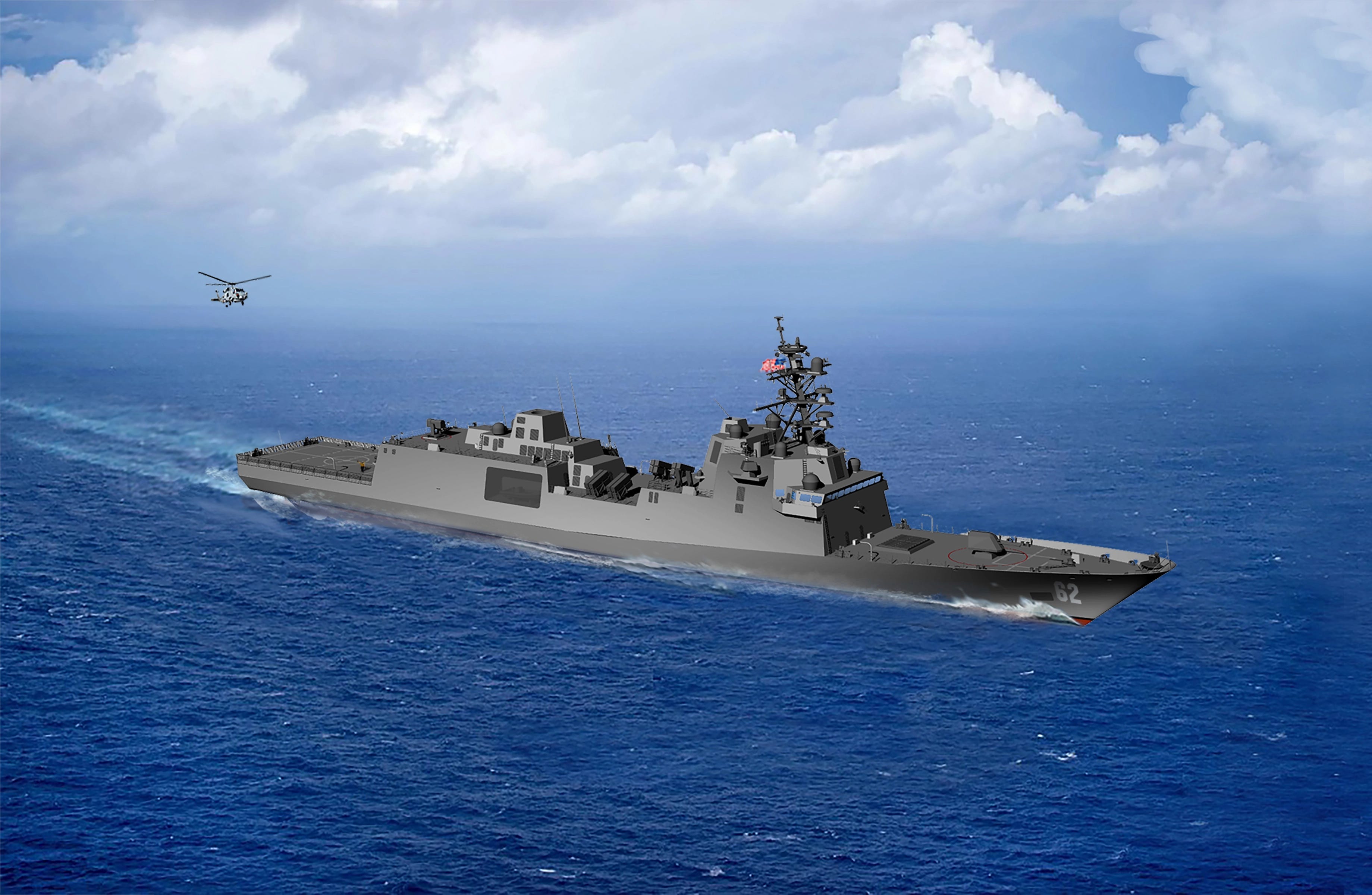
But the Navy then could not follow through on its minimal modification promise. US shock and hardening standards were higher than European norms, leading to a heavier hull. The Navy demanded common propulsion between the Constellation and existing Burke destroyers. The Aegis Combat system, with SPY-6 radar and Mk41 VLS, was larger and heavier than European equivalents with more cooling requirements.
Together, this ended most commonality with the original design. The hull was lengthened by 24 feet, widened by 10, and had a 10% increase in tonnage. This threatened the speed requirement, which then led to further design changes. The Navy finally settled on a ship that had on 15% commonality with the original FREMM: down from 85% in the original plan. In 2024, the Government Accountability Office (GAO) wrote that the “unstable design had stalled construction, and the functional design was less complete in 2024 than at construction start.” Constant requirement changes invalidated existing work, causing the project to lose progress.
And yet, despite the woefully incomplete design, the Navy started construction. This started in 2022, when the design was thought to be 80% complete. In reality, it was far lower, as a new set of requirements were added that invalidated existing completed work. And as requirements changed, the yard built out of sequence, assuming designs for components that often ended up wrong and required redoing. Workforce instability then started to seep in. Workers hired for fixed terms left, leaving work undone, and the yard couldn’t hire replacements. Costs steadily rose while little actual progress was made.
By 2025, the economics had now entirely inverted. The Constellation was projected to cost as much as 80% of an Arleigh Burke destroyer, while being a far less capable ship. The entire point of a frigate is to be a low-cost alternative to do the jobs you wouldn’t risk a destroyer for, and so, at the current cost, the frigate was pointless. The entire class was cancelled and the Navy procured additional Burke’s instead. The first two ships under construction were allowed to complete, but only because the Navy wanted to keep the Wisconsin shipyard building them open for future procurement. The Navy is now trying again by pivoting to an even less ambitious design, based on the US Coast Guard’s Legend-class patrol boats, and is contracting the work to Hanwha.
The Constellation program failed for the same reason the LCS did: scope-creep. The GAO has made a number of observations on why this happens. New ships have too many stakeholders, all of whom are empowered to inject requirements at any stage of construction. These requirements then lead to an entirely bespoke design. This is in contrast to the commercial market’s approach of having a clear idea for a ship, drawn from real experiences, and accepting only the requirements that match that initial thrust. The Navy also has the curse of unlimited resources and no deadlines, which allows it to expand projects indefinitely without having a cost ceiling or a target date constraining it. Combine this with the organizational incentive for every officer, who wants to take credit for the improvements they can claim once their requirement is incorporated but has little stake in the timely delivery of the project, and the pathology causing design instability is clear.
And then, in both the Constellation and LCS programs, builders started construction work well before the design reached maturity. This is termed “concurrency” in a lot of the literature, and it’s a consistent theme in all recent Navy procurement. On Constellation, concurrency compounded design instability, as each design change also required major physical reworking. You can imagine how this also creates a sunk-cost fallacy for the builder and the Navy, both of whom will resist major design changes introduced after construction is initiated to preserve the progress made so far.
The GAO has been complaining about concurrency for two decades now, but it still persists because several perverse, interlocking, organizational incentives that resist reform.
To understand this, consider how a commercial ship is commissioned. In a commercial transaction, the buyer and builder work together to design the ship. The buyer supplies use cases, which the builder turns into concrete ship requirements. These are negotiated back-and-forth, where the builder uses their in-house technical expertise to push back against technically infeasible options, while the buyer uses their own experience to reject inflated price estimates or timelines. Once this negotiation is settled, the buyer signs a fixed-price contract, where they pay a predecided price to deliver the ship at a specific time, with allowances for various delays. Then the ship goes through detailed design, where the builder usually modifies a well-known design to match any unique requirements. The builder is incentivized to be thorough here because they are responsible for all costs and delays.
This process forces the builder to shoulder all costs that arise during production, which incentivizes them to price accurately, provide realistic time estimates, and push against impossible requirements. It works because commercial ships only have small variations between buyers, allowing shipyards to reuse existing designs to make costs and timelines more predictable.
The Navy procurement process is entirely different. Every Navy acquisition is a completely unique hull with distinct requirements around speed, propulsion type, fuel efficiency, and most recently, stealth. It also has to incorporate a plethora of combat systems into the final construction, each of which has unique packaging and cooling requirements. This means Navy shipbuilders have very few options to improve output predictability, which makes fixed-price contracts unviable. Instead, the Navy uses cost-plus contracts where the builder provides a best-effort estimate of cost and time and the Navy bears responsibility for any overruns.
But the way the Navy implements this creates the opposite incentive. Now, shipbuilders are incentivized to start building as soon as possible because they only receive revenue once steel is cut and they don’t bear the burden of cost overruns or delayed delivery. The Navy also encourages starting early because construction is often the only way to prevent stakeholders from introducing new requirements to a project. And finally, starting a project significantly increases the costs of its cancellation. This means stakeholders facing pushback may start construction early to ensure it has to go forward. Politicians representing the district the shipyard is located in also want to start construction as soon as possible as it lets them tout the new jobs created to their constituents.
Together, these two interlocking problems mean the Navy has not executed on any of its recent procurement projects. An excess of stakeholders without any overseeing authority means requirements keep changing and the design is never settled. Concurrency turns design churn into cost overruns, and creates sunk-cost fallacies that hamper intelligent investigation. These issues are then compounded by the Navy’s lack of robust in-house design expertise. This means the Navy cannot determine what requirements are feasible, what the additional cost is, or whether the current design is mature enough for construction. They can’t question optimistic builder estimates and can’t freeze requirements or defend a requirements baseline. The Navy’s organizational incentives always induce design instability and concurrency, and the dearth of in-house expertise means there’s nothing pushing against them.
As the GAO states, the solution required is nothing short of generational. The Navy is wedded to a sequential developmental model, where requirement gathering, then design, then construction, and finally, delivery, complete in a continuous waterfall. Every modern organization has abandoned this methodology, because in sufficiently complex projects, initial assumptions will be incorrect and adjustments will need to be made. A material choice during design could prove unviable during construction, requiring a design change. A specific technological choice may not work under the ship’s expected conditions, requiring cascading updates. The linear model struggles to handle these scenarios, leading to the failures we see above.
Instead, the Navy needs to adopt an iterative, “agile,” development process. Engineers should use design-implement-test loops to validate the hardest questions before full construction. Designs should explicitly call out unknowns and highlight potential “unknown unknowns,” so these can be planned for, and engineers should derisk by minimizing “one-way doors”: decisions that cannot be undone without triggering rippling changes across the project. Functional design needs to be sufficiently ready before construction starts, but the construction process should lead to iteration on the design. iteration should be expected, and good initial planning should ensure that construction can progress while the design evolves.
The GAO has proposed each of these changes across 50 or so reports since 2009, with 90 accompanying recommendations. The Navy has implemented just 30 of them, and from my qualitative examination, it chose the least impactful ones to implement. Meanwhile, the McClung-class landing ships, the Navy’s latest procurement project, is following the same trajectory of the Constellation and the LCS. Perhaps that speaks to, in government, how vast a gulf lies between knowing and doing.3
The Industrial Base
Procuring a new ship is one thing; ramping production of an existing design is another. Procurement is a problem of abundance; reforming it is a matter of changing the process by which an abundant resource—money—is expended. But expanding production requires investing that abundant resource to increase the supply of scarce resources: shipbuilding facilities and shipbuilding workers.
In America, however, the decades since 1991 have seen those facilities steadily contract or close. Nowadays, there are only two yards that can build nuclear submarines in the US: General Dynamics Electric Boat in Connecticut and Huntington-Ingalls at Newport News. These yards each produce separate parts of the submarine, so overall construction remains serial. Similarly, nuclear carriers can only be built at Newport News, one a time (though the Navy is working towards bulk buys). The story is similar for conventional ships. Burke class destroyers, the only surface combatant the Navy can actively produce, can be built only at two yards: Bath Iron Works in Maine and an Ingalls yard in Mississippi. Each can produce one destroyer at a time, and build times have slipped to almost 4 years per destroyer.
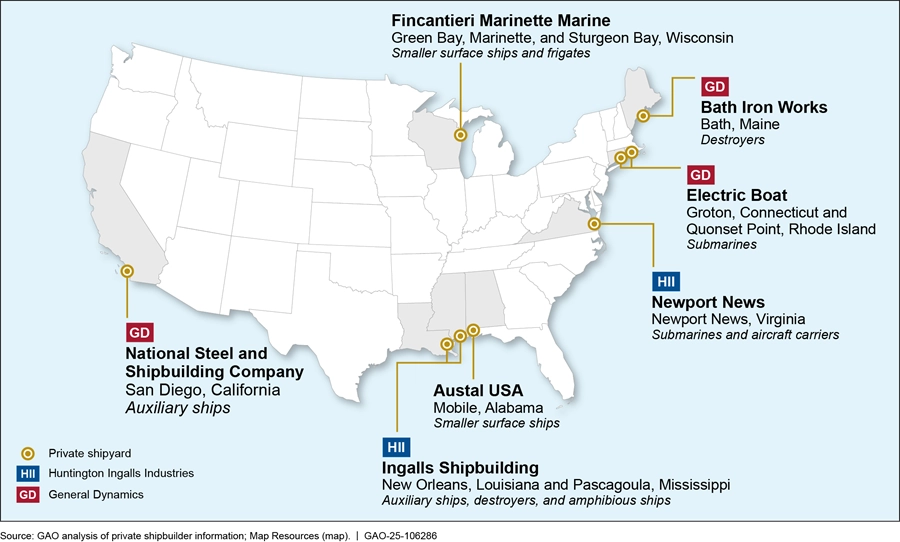
Altogether, this means American naval ship production has slipped to 1.8 per year—compared to China’s ~6.
And as these facilities contract, so does the naval workforce. Lower demand from the Navy caused mass shipyard downsizing. Those tradespeople moved into different lines of work, while the pipeline for future skilled labor fell off sharply. In 1991, the US had 218,000 shipyard workers; in 2023, that number was down to 145,000—a 33% decrease. These workers have an average age of 55, and their retirement coincides with a historically small incoming pipeline. And among those newer workers, low pay and seniority-based work allocation leads to attrition rates of 20%, often reaching over 30% in the most critical trades. Overall, the Navy projects a 250,000 worker deficit over the next 30 years.
Replenishing this workforce is a decades-long endeavor. Training a nuclear-certified welder can take 3 years, and it can take years of experience beyond that to make them fully qualified to build submarines. Apparently, General Dynamics is seeding its recruitment pipeline with fifth graders to build a workforce 15 years down the line.
At the very least, wages need to rise significantly. Judging from the scale of the shortage and how difficult it is to work at a shipyard, shipbuilding jobs should pay top-of-market in that area; instead, the average job pays just $62,400, which is above median, but lower than comparable employers, and considerably lower than what a skilled tradesperson could make elsewhere. Last year, Navy Secretary Phelan complained that unskilled jobs at Amazon warehouses and Buc-ee’s establishments near shipyards outcompete the Navy for its skilled workforce. Nowadays, ICE recruitment, with its $50,000 sign-up bonuses, will bleed the Navy even more, as will the massive skilled trades demand created by datacenter construction.
What the Navy needs is investment continuity. It wants shipyards to build a pipeline of workers and to invest in improvements that last beyond any given contract. This permanent capacity then enables more efficient delivery into the future. The Navy has one main lever to encourage shipyards to make these investments: providing stable demand. Its traditional approach is publishing annual shipbuilding plans to provide a steady demand signal to shipyards. The idea is, if a shipyard knows it will be contracted to produce some number of ships over the next five to ten years, it can expand its workforce and invest in improvements based on that expected revenue.
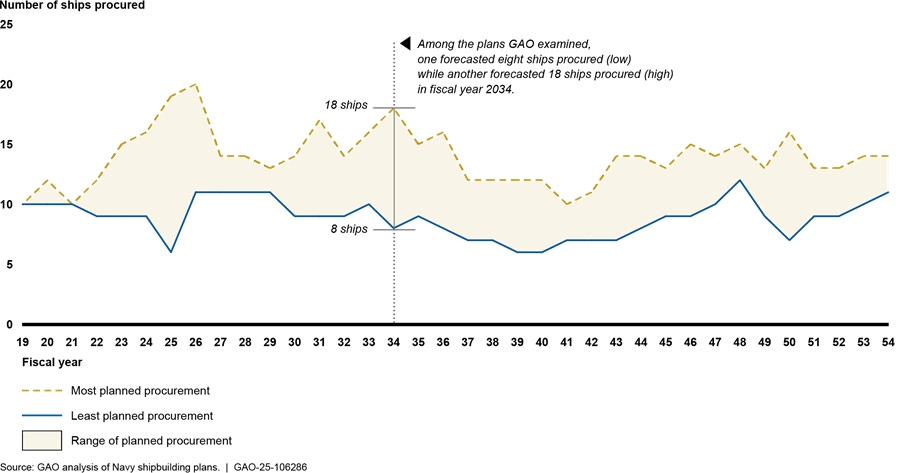
However, the Navy is unable to adhere to its own plans. The graph above shows the highest and the lowest procurement numbers the Navy has published for a given year. On average, the spread is about 8 ships, and from a sampling of these reports, I found that the Navy follows the worst version of this pattern: it publishes higher numbers earlier but revises them down as the year gets closer. Cutting procurements undermines any confidence shipbuilders have in Navy commitments. What happens if you invested in production to build 12 ships, but suddenly your contract is cut to 6?
The Navy has thus expanded the set of investment incentives it offers. It disburses a larger portion of the contract value at signing to provide early revenue for investments. It will accelerate depreciation schedules of delivered ships, so the yard can recover more of its investment earlier through tax deductions. New contracts also often include explicit provisions that increase the total fee but tie a portion of that fee to investments. The goal is to both create additional incentives to invest and provide additional funding at signing to enable that investment.
And yet, despite these programs disbursing hundreds of millions in additional funding to shipyards since their inception in the early 2000s, the Navy hasn’t seen a measurable decline in backlogs or an improvement in production times. The GAO has written extensively on how the Navy doesn’t even have the infrastructure to track a return-on-investment metric. Compare this to China or South Korea, who paired shipbuilding investments with robust performance metrics and executed clawbacks against underperforming firms. The Navy also has reported that firms, despite investment incentives, often prefer having a backlog of orders to ensure a steady flow of work. This is yet another impact of the Navy’s inability to signal consistent demand.
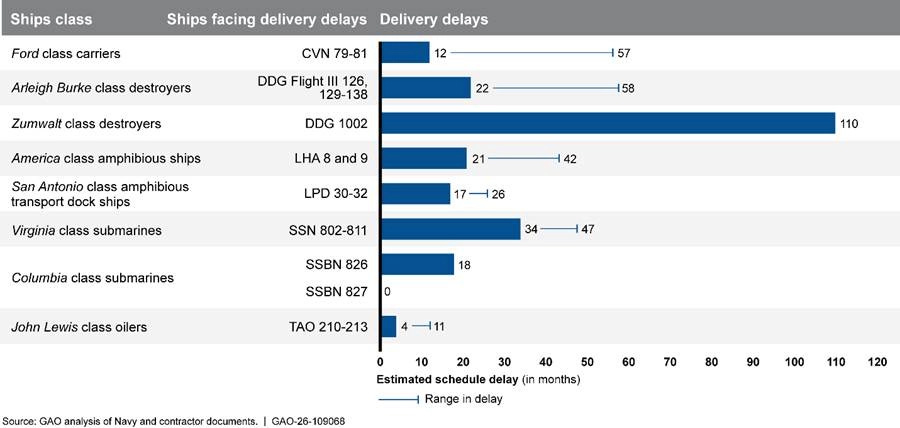
Part of the issue is that the Navy doesn’t have a coherent investment strategy. Nuclear submarines, for example—like jet engines—depend on an ecosystem of 5,000 different suppliers for increasingly specialized components. To use a programming analogy, this network resembles a directed-acyclic-graph: every supplier subcontracts components downstream, and suppliers often provide different components to companies closer to the end-product. The shipyard is only the place of final assembly, and while direct shipyard improvements are useful, they are only one bottleneck. The Navy gives the example of a single company that provides explosive welding capability for all submarine construction, and touts its “success” in securing a 30-year contract with this company to ensure it doesn’t fold.
The Navy needs to audit the entire supply graph, find other high-leverage points, and invest in them directly to expand production. Its 2025 roundup identified castings, heavy machining, and mission systems work as the core gaps—it should seed new companies to provide redundancy in these areas. At the very least, it should produce cost-estimates for expanding the industrial base so they can be included in the annual National Defense Authorization legislation, which is something it has heretofore been unable to do.
And yet, even if all of these efforts are implemented, they’re unlikely to cause a major revival of the industrial base. As we’ve discussed, American shipbuilding is both a monopsony and an oligopoly: the Navy is the only major buyer, but there are very few builders it can buy from. This gives the Navy two competing tensions: it wants to increase competition, which drives efficiencies in its contractors, while trying to preserve its existing contractors. Put differently, it’s aiming to break the oligopoly by introducing competition but also trying to expand each individual company in that oligopoly at the same time, and it’s doing this while being the only source of demand. These two contradictory ends cannot both be met.
What seems to be happening right now is that shipbuilders, recognizing the market isn’t competitive, do not feel compelled to invest. They bank the Navy’s early contract disbursements as revenue and make the minimum investment required to service that contract, and they maintain a backlog of orders as an assurance of continued business. Forcing them to make the long-term capital investments the Navy needs requires both a competitive market that imposes cost pressures, and counter-cyclical demand that isn’t subject to political vagaries. Neither of these are possible in a government monopsony, even when that government is the richest buyer in the entire world. The only other buyers available, however, are commercial buyers—but they all decamped from the US after 1981.
The Commercial Collapse
To call the American commercial shipbuilding industry “in decline” is to engage in understatement so severe you’ve obscured meaning. American commercial shipbuilding is not in decline, it is a cancer patient on the precipice of death, and with each passing day, the sickness worsens.
The numbers speak for themselves. American shipyards produced 5 large oceangoing commercial vessels last year; China produced over 1700. American market share in total commercial shipping has fallen to 0.1%. That remaining market share exists only because of the Jones Act, which mandates that traffic between American ports must be carried on American ships. China has 232 times the ship construction capacity of America. A single Chinese shipyard has more construction capacity than the entire American industry. Last year, a single Chinese company, the China State Shipbuilding Corporation, built more commercial tonnage than the United States has since the end of World War 2.
Low capacity leads to higher costs across the board. American freight ships are, on average, 5 times more expensive than their Korean or Chinese counterparts. It also raises production times for each individual ship: American shipyards take roughly twice as long as foreign competitors to produce an equivalent ship.
The remaining American fleet, largely produced before the 1980s, is in steady recession. Out of the 2,926 US-flagged oceangoing vessels in 1960, there are only 188 left. More than 99% of American international seaborne trade now travels on foreign ships. For example, despite being the world’s largest liquid natural gas exporter, there is exactly one US-flagged LNG tanker—and it was built in France.
In traditional economics, commercial shipbuilding leaving America is just Ricardian comparative advantage playing out in the modern era. Shipbuilding is very labor-intensive and America is a high-wage country. HD Hyundai, for example, employs 40,000 skilled laborers at its Ulsan shipyard, and their wages make up 40% of the cost of each ship. Meanwhile, as we’ve discussed, even Navy shipyards in the US can’t pay enough to retain their workforce, and this is for a price-inelastic government buyer; the commercial market is far less forgiving.
These shipyards export to a very competitive market. Shipping margins are low, which makes shipbuilding margins even lower. To succeed in this market, shipbuilders are vertically-integrated, have government backing, and consolidate aggressively. The engineering for cargo ships is largely commoditized: each company competes on cost and size. The larger the ship, the more revenue it can generate and the less maintenance-per-unit it requires, so shipbuilders try to go as large as possible. The primary moat is scale. Building more ships allows more amortization, driving down costs and thus enabling gains in market share.
Putting this together, commercial shipbuilding is almost exactly the industry you’d expect to leave modern America. The US has a huge shortage of skilled labor, many regulations preventing the sort of continuous rebuilding modern shipyards need, and a population that can take easier jobs for better pay. The market itself is low-margin and cyclical. Shipbuilders are constantly on the verge of bankruptcy, stuck in the corporate equivalent of the Malthusian trap. For example, Hanwha Ocean (formerly DSME) is the fifth largest shipbuilder in the world by revenue, and yet, the Korean Development Bank still had to pour ~$7B into it from 2008 to 2020 to stave off bankruptcy.
For all of these reasons, the US has not had a world-leading commercial shipbuilding industry since the 1840s. Instead, since the Civil War, American shipbuilding has followed geopolitical cycles, growing during conflict and withering during peace. Major government subsidies during WW1 built up a considerable American merchant marine. These fell into disuse during the Great Depression, but as WW2 approached, the US launched another industrial policy push to rebuild commercial shipping. This backed the lend-lease program and then the massive sealift needed to ship American materiel to Normandy and the Pacific. After the war, however, subsidies were phased out and the industry fell back into cyclical decline. American shipbuilders instead moved their businesses to a rapidly westernizing Japan, which grew to become the world’s largest shipbuilder.
The exception to this pattern came in 1970, when, with the Merchant Marine Act, the US launched its biggest peacetime shipbuilding program. This had early success, and in 1973, the US was briefly the world’s second largest shipbuilder (after Japan). But the oil crisis created a tanker glut which drove prices down and killed demand. American shipyards began to close even with subsidies. Reagan drove in the final few nails in 1981 when he repealed the Construction Differential Subsidy (CDS), where the government paid shipyards 50% of the difference between domestic and foreign construction costs.
There’s some irony here that the President who enabled the final burst of American naval shipbuilding also laid the groundwork for its subsequent death.
The collapse thereafter was immediate. In 1981, American shipbuilders had 69 orders for large oceangoing vessels; by 1988 this had plummeted to 0. No new oceangoing commercial vessels were ordered after 1984 for the rest of the decade. Shipyards transitioned to the new, heightened Navy demand, but once that waned in the 90s, they never recovered. What remains is a monopsony. The US Navy (USN) now makes up 95% of the revenue for American shipbuilders. Not a single American ship has been produced for export in three decades.
We’ve already discussed the impact of this. The Navy’s sealift capacity is fatally degraded, but the National Defense Sealift Fund’s regulations (U.S.C. § 2218) state that it cannot source more than 10 of its ships from foreign producers. American shipyards lack the capacity to handle Navy procurement, while the industrial base that enables them is in a state of frozen decay. The Coast Guard, after a decade of failed icebreaker procurement, is now buying icebreakers from Finland. The Navy now even struggles to repair its own ships, and has started contracting that to Korean companies.
Historically, this state of naval incapacity isn’t unique for America. As a continental nation protected by two oceanic borders, a navy has been an elective power-projection tool, not an existential force (like it was for Britain). Thus, the Navy has also mirrored the cycles of the commercial industry. Until WW2, it decayed during peacetime and made up for it with surge production in times of strife.
But unlike those past eras, the United States of 2026 is no longer an industrial nation.4 When, for example, FDR inaugurated his shipbuilding surge in 1941, he was redirecting the largest industrial economy in the history of the world to ship production. In his time, the US was the world’s largest steel producer, had reusable production lines that could be quickly reoriented towards military production, and had a huge surplus of industrial labor that could be quickly redirected. Today, that same push would stutter for lack of inputs. Meanwhile, the engineering requirements to produce modern ships have steadily increased. Every ship, including cargo ships, has gotten larger, more complex, and more specialized than it ever was. Just as repurposed car manufacturing lines can’t build planes anymore, today’s stagnant shipyards can’t scale to mass production without years of effort.
What’s Being Done
The Trump administration has actually launched several overlapping efforts to revive American shipbuilding. On April 9th, 2025, President Trump signed the “Restoring America’s Maritime Dominance” executive order, which established the Maritime Action Plan (MAP). This outlined a broad set of objectives and policy recommendations across four areas: supply-side shipbuilding reforms, workforce expansion, strengthening the industrial base, and, most interestingly, a set of policies to create and fund demand for domestically constructed ships.
There are four facets to this. The first is the Maritime Security Trust Fund (MSTF), a government funding pool, derived from fees on foreign-built vessels transiting American ports, that is earmarked for other demand-side programs. This funds Maritime Prosperity Zones, which are akin to China’s Special Economic Zones but focused on shipbuilding capacity. It modernizes federal financing tools to allow more loan disbursal to shipyards. And finally, it institutes cargo preference for American ships—in effect, strengthening the Jones Act for government cargo.
The SHIPS for America Act is an in-progress legislation that implements the demand-and-funding architecture outlined above. The administration plans to submit this to the House after its FY2027 budget request passes, so it’s hard to say how much of these changes will actually come into effect.
The final layer is the “Make American Shipbuilding Great Again” agreement between the US and Korea. Here, Korean shipbuilders pledge to invest $150 billion over the next 10 years to build and modernize shipyards in America. The flagship project is Hanwha Philly, a $5 billion plan to add two docks and three quays to an existing shipyard to raise capacity from 1 ship a year to about 20. This is anchored by orders for 2 LNG tankers and 10 medium-size tankers. The first delivery is predicted to come in 2029. This is the first pillar in a larger plan of offering foreign shipbuilders contracts for ships built in their own yards, with a commitment to subsequent investment in American domestic production. The Coast Guard’s purchase of Finnish icebreakers will follow this pattern as well.
In general, these measures make sense. America’s strength is its massive market, while its weakness is its decaying industrial base. Policies that leverage that latent demand to expand the industrial base are fruitful ways to expand national power. The risk is, as always, continued government support. The 1970 Merchant Marine Act led to major short-term growth, but this was undone by the Reagan administration. This latest push doesn’t even have a legislative arm yet. Thus far, it’s being orchestrated solely through executive orders and trade deals. All of these are ephemeral mechanisms that can be undone by a future democratic administration—or even just Trump himself next year5. [footnote: Stephen miller certainly tried - Korean ICE sweep].
But if the SHIPS for America Act does pass, however, then there will be a dedicated funding stream for shipbuilding revival. This is crucial. The Navy has failed for decades to induce private investment because it is incapable of providing credible demand signals. A mere executive order would be even less credible to shipbuilders, who have to plan in decades. But a law creating a dedicated funding stream makes the signal far more credible, which makes the entire agenda far more resilient.
The MASGA component in particular is a unique victory for both the US and Korea. The US gains process knowledge to operate a large-scale shipyard—something no American company has done in the modern age. Hanwha is also planning to rotate American workers to Korea for training, which will seed a new skilled workforce in the US. For Korea, Hanwha’s commercial yard is a stepping stone to contracting directly with the Navy to design and build warships. It’s a huge new revenue stream for them, and allows Korea to bring lessons from American defense technology back to Korea’s own burgeoning defense industry.
I think, if this program is sustained for the next two decades, it will be a major triumph for the United States, and perhaps one of the Trump administration’s few positive legacies.
However, there are clear limitations. This does nothing to solve the problems in Navy design and procurement—those are entirely distinct. It also doesn’t improve production rates for nuclear carriers and submarines, the long-tail engineering-constrained Navy outputs, which require a much finer grained industrial base expansion. The MSTF also does not include any provisions for clawbacks for underperforming firms, which risks the fund becoming yet another toothless subsidy to the oligopoly. And finally, the Korea-rotation plan creates a “bridge” workforce for immediate needs, but doesn’t do much to actually expand the workforce within America. Most likely, Hanwha will bring in Korean workers to address the immediate shortage, like TSMC using Taiwanese workers on its Arizona plants.
Nevertheless, these steps are significant. With this, America will produce its first globally competitive, domestically manufactured, oil tankers since the 1970s. They will create the largest commercial shipyard in the US, aiming to produce 20 hulls a year in a country that produced fewer than 10 oceangoing vessels in 2025. Together, these two milestones will seed the beginnings of a new export industry in America.
For The Future
Trump’s attempted reforms are a decade late, and they do not address the Navy’s two core issues: procurement woes and the industrial base. The administration is touting American-made LNG tankers, but these are not an end goal—only an instrumental one. The commercial industry, after all, is valuable only to buttress naval construction, but whether that comes to be remains in question.
The reforms we need are far wider. The Navy’s procurement is fatally flawed and has resulted in two generations of failed acquisitions that have left the fleet unprepared for tomorrow’s war. The industrial base has contracted, cratering naval construction capacity. And just as these factors reach their nadir, China’s peer threat has fully matured. It now threatens every foundation of American power.
This future was chosen by that post-1991 generation. Their so-called “peace dividend” produced our current military incapacity, and their lingering influence maintained our inertia. They were convinced that further military expansion in a unipolar world was vanity; now, only their own vanity is clear. China “rose” two decades ago but the US is only now adjusting to this reality.
Yet decline was a deliberate decision, and it is one that can be undone. The US has retained many advantages from which it can rebuild its naval power. This reversal, however, will require in abundance the one resource that America has a scarcity of: sustained political will.
Appendix: The Jones Act
You cannot write an article about American shipbuilding without mentioning the Jones Act. It is perhaps the biggest bugbear of today’s technocratic edifice, uniting the entire center-left and center-right in opposition. The CSIS, The Heritage Foundation, Cato, The Mercatus Center, and the Brookings Institution all support its repeal. It may seem like an oversight, then, that it’s only been on the periphery of this essay.
The Jones Act, officially known as The Merchant Marine Act of 1920, regulates a number of different aspects of domestic seaborne freight. Its most important provision states that all cargo traveling between US ports must travel on ships that are built in America, owned by companies that are 75% American-held, fly the US flag (i.e. be registered in the US), and the majority of the crew must be US citizens or permanent residents.
It’s obviously true that the Jones Act is bad policy. It is protectionism without industrial policy taken to its logical extreme. Over the 106 years since its creation, it has led to inefficiency in American shipyards, higher shipping costs for American companies, and higher costs for American consumers. It has created a parallel industry of expensive Jones-Act eligible cargo ships. These make a parody of made-in-America requirements, importing some 70% of their components from abroad with only hull fabrication and final assembly occurring in inefficient American shipyards. The Jones Act also interferes with critical government functions. Hurricanes Irma and Maria devastated Puerto Rico, but supply ships already in the area couldn’t be unloaded for days because they were foreign-made. The same happened with Katrina in 2005. Nowadays, it’s common practice for presidents to issue Jones Act waivers during any national emergency. Most recently, President Trump did this to ease supply disruptions after launching the 2026 Iran War.
And yet, I haven’t focused on it because for ship construction, especially Navy warship construction, it is legitimately not relevant. The Navy struggles because of America’s decaying shipbuilding industrial base, a decades-long decline in shipyard investment, and a generational workforce shortage, along with its own internal procurement struggles—not protectionism. Commercial shipbuilding follows the same pathologies. Indeed, that a domestic commercial shipbuilding industry exists at all is due to the Jones Act; without it, American shipping companies would just be consumers of Hanwha or Hyundai or CSSC like everyone else.
Arguably, the battle is worse in this future, as China has access to Western technology and the support of its East Asian neighbors. I increasingly think that authoritarianism weakens China, and that it has achieved as much as it has despite its meddling rulers shows how much further it could go in a liberal-democratic system.
“Army Navy” sounds weird, but it has nothing on my favorite Chinese military subdivision name: the People’s Liberation Army Navy Marine Corps, or the PLANMC for short.
When I first heard about DOGE, I imagined this was the type of problem it would work on. There are ten thousand problems just like this one in government. Government agencies don’t have real cost pressures or deadlines, struggle to reorganize their workforce, and cannot easily hire or fire. This is a breeding ground for stagnation. Career incentives organize themselves around these constraints, where “success” within the system is rewarded and it’s always a major career risk to attempt organizational change. The reason private companies implement efficiencies is because of a competitive market and limited funds; none of this exists in government.
A very common pushback I heard on previous articles was that actually, the US hasn’t de-industrialized: real manufacturing output growth has risen along with private sector output growth, and productivity growth has been the cause of declining employment in the secotr. This is entirely false. Susan N. Houseman, among others, has described how most of the US’s manufacturing growth since the 1980’s comes from the computer industry, and most of that gain arises from the way statisticians account for product improvements in the industry. An example is that if a wafer has twice as many transistors but is sold at a similar price, economic statistics with mark that as a 2x increase in output. But, the total number of wafers produced is the same. This is called hedonic adjustment, and it makes up the vast majority of manufacturing productivity growth since the 1980s. Houseman also states that outsourcing intermediate inputs is misread by those agencies as falling input costs and rising domestic productivity, rather than what it actually is: hollowing out the domestic base.
Stephen miller is certainly trying his best.
At some point I'll try to dig up an article written by someone who worked as a customer-side inspector at a Korean shipyard.
It was simply beautiful.
A day-to-day inspections from both the customer and manufacturer side. Quick suggestions, quick decisions... if someone doesn't show up, it's simply treated as if it happened. The work moves on.
It's a completely different mindset from what you see in overregulated Europe, where nothing can happen until at least five inspections have signed off on it, and the sky is the limit after that.
Everything is optimized for efficiency. System oriented instead of checkpoints.
Until the US starts moving in that direction, I think talking about rebuilding a domestic shipbuilding industry is mostly wishful thinking. That said, sourcing more and more components from abroad could still be important for the future.
I have a lot more personal experience with concept creep, though, and I think that's where the mindset itself has to change. It's one of the things that's increasingly holding the West back.
I've had to deal with complaints where the customer kept insisting that something "failed to do its job" even though it was never designed for that job in the first place.
Well... because it wasn't designed for that.
Three small systems are very often far more efficient than one giant do-everything solution.
Even if I just look at recent military developments, we've essentially rediscovered the value of mass-producing simple, purpose-built, and sometimes even disposable equipment.
Take the US Navy, for example. It doesn't currently operate corvettes, while both the LCS and the Constellation programs show the same tendency: they want every ship to do everything.
Sure, I know. Easy for me to say.
But corvettes are purpose-built by design. Building industrial capacity around something like that could be an excellent gateway toward larger ships, creating a pipeline both for the workforce and for the underlying industrial know-how.
The whole thing gives me the same feeling as battleship design before the Second World War.They're trying to build things that are simply too big and trying to make them do too much.
Very interesting article. I hope it can be sent to Pete Hegseth!